
STEM Careers in Engineering in Australia
Many young men and young ladies who are Students engaged in STEM in Secondary Schools activities (eg STEM Racing and Robogals) as well as other STEM oriented Secondary Students might well be interested in a career in Engineering as their education evolves. Engineering provides a wide range of interesting opportunities for a very satisfying career. These Secondary Students might well be interested to know that there are five main occupations in Engineering which are quite different to each other and involve varying proportions of skill of hand and skill of mind. This situation is made somewhat complicated because persons in all the five Engineering Occupations are known as “Engineers” in Australia, the UK and many other English speaking countries. This in turn causes quite a bit of confusion around “What do Engineers do?”.
Some guidance may therefore be useful to help clarify things so these Secondary Students can choose their best prerequisite secondary school subjects appropriately as well as the University/TAFE/Apprenticeship courses they propose to undertake following their graduation from Secondary School. The aim being for each Secondary Student interested in Engineering to enter a career in the Engineering Occupation which best suits their personal skills and interests overall.
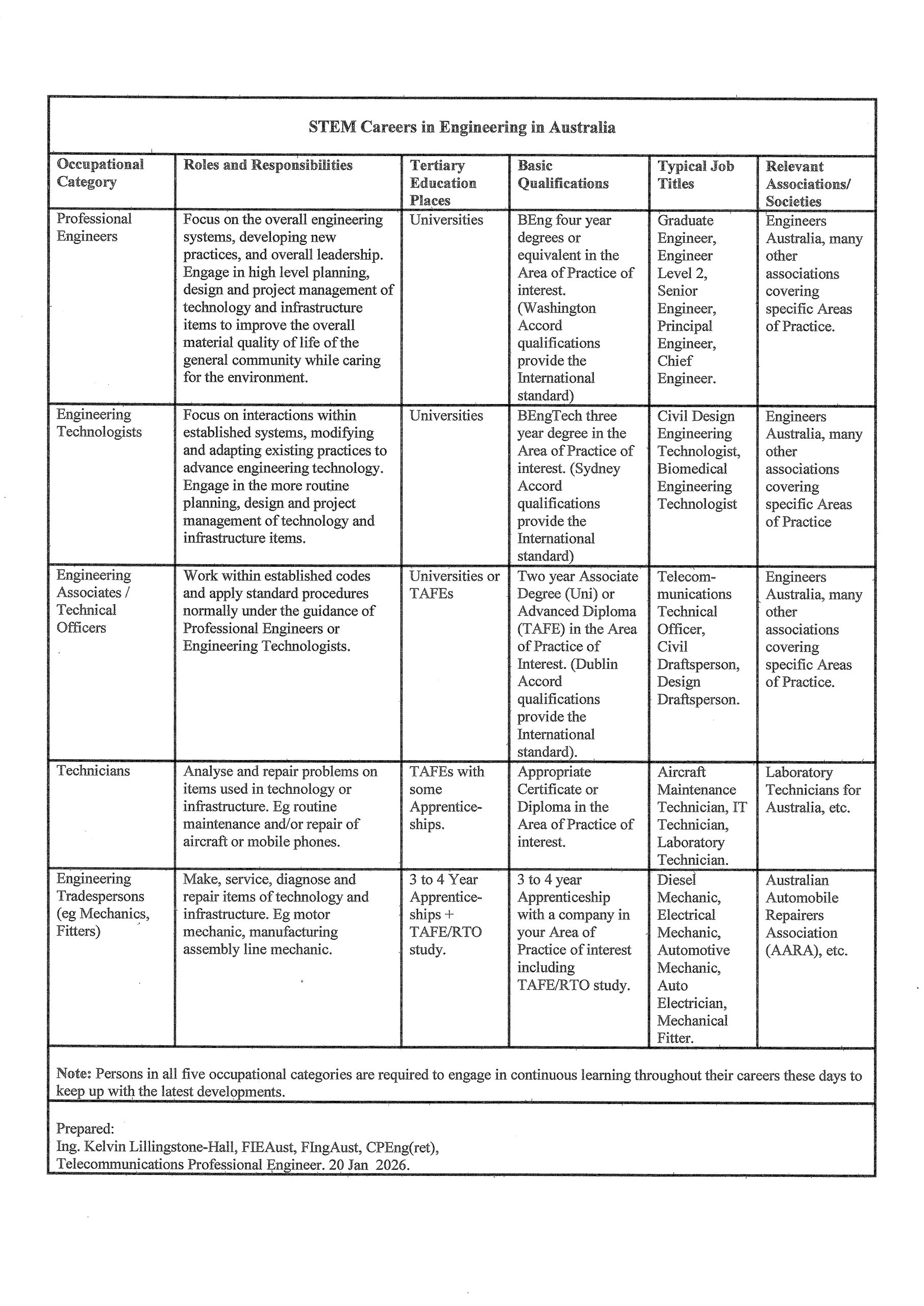
The Five MAJOR OCCUPATIONAL CATEGORIES in ENGINEERING are as follows:
- Professional Engineers.
- Engineering Technologists.
- Engineering Associates / Technical Officers.
- Technicians.
- Engineering Tradespersons (such as Mechanics and Fitters).
Then there is the excitement of these Secondary Students also choosing an Area of Practice that suits their personal interests. There are about 30 AREAS of PRACTICE in ENGINEERING including the following:
- Civil Engineering. Focuses on infrastructure design and construction, including roads, bridges, buildings, and water systems. Sub-specialisations include structural, geotechnical, transport, and environmental engineering.
- Mechanical, Industrial, and Production Engineering: Involves the design of mechanical systems, optimisation of complex processes, and manufacturing. This includes specialisations such as aerospace, automotive, robotics, and marine engineering.
- Electrical, Radio, IT and Electronics Engineering. Covers the application of electricity, electronics, and electromagnetism, including electricity power systems, telecommunications networks and computer networks.
- Chemical and Materials Engineering: Combines principles of chemistry and biology to develop processes for producing chemicals, pharmaceuticals, food, and other products. Also petroleum refineries.
- Other Engineering: This broad category includes a range of specialist areas such as in biomedical engineering, agricultural engineering, naval architecture, and acoustic engineering. Also mining engineering as well as coal, gas, solar, wind and nuclear generation for powering electricity networks.
See overview table:
Once they have graduated from their BEng degrees, or equivalent qualifications, from a university as certified by Engineers Australia, Professional Engineers may use the Ing. prefix title and/or the PEng (Professional Engineer) suffix title. They may also join the Ingenieurs Australia Society Inc and receive the MIngAust or FIngAust suffix title as appropriate for their experience and achievements as a Professional Engineer. As members of Engineers Australia they may upgrade their PEng suffix title to Chartered Professional Engineer (CPEng) by having their experienced certified for such by EA. As members of the Association of Professional Engineers Australia they may upgrade their PEng suffix title to RPEng (Registered Professional Engineer) by having their experience certified for such by APEA. Professional Engineers who also hold a PhD qualification may use the Dr.Ing. prefix title in place of the Ing. one which means that they will be distinguished from medico GPs who use the Dr. prefix title.
Professional Engineers interested in careers guidance in Secondary Schools and Teachers interested in STEM in Secondary Schools might find the above article of interest.
All those interested may feel free to join the new “STEM in Secondary Schools” group on LinkedIn for further information on STEM (Science, Technology, Engineering and Math) activities, and relevant careers guidance information, across Australia as the group evolves over the coming years.
Prepared:
Ing. Kelvin Lillingstone-Hall, FIEAust, FIngAust, CPEng(ret),
Telecommunications Professional Engineer, 20 Jan 2026.